
Currency Impact on Investment Returns Calculator
See how exchange rate movements affect your real returns
Your real return in your home currency has two parts: how the asset performed, and how the currency moved between buying and selling. This tool splits the two and tells you, in plain words, whether the currency helped or hurt. It updates as you type.
Your investment
Free · No sign-up · Updates as you type
The currency you measure your wealth in.
The currency the investment is priced in (e.g. USD for a US stock).
€
How much you put in, in your home currency.
How much the investment itself rose or fell, e.g. 10 for +10%.
How did the currency move?
1 EUR = ? USD
1 EUR = ? USD
= USD strengthened 4.8% vs EUR
Your real return in EUR
+15.2%
€10,000 → €11,524
In plain terms: your investment returned +10.0% in USD. USD strengthened 4.8% vs EUR, which added 4.8%. Together, in EUR you end with €11,524, a +15.2% return.
Investment return
+10.0%
Currency return
+4.8%
Total (home currency)
+15.2%
Hedged
€11,000 (+10.0%)
Unhedged (actual)
€11,524 (+15.2%)
How the currency move changes your return
You cannot predict exchange rates, so here is your home-currency return across a range of currency moves, with your asset return held fixed. Your current case is highlighted.
| Currency move (USD vs EUR) | Your return | End value |
|---|---|---|
| -10.0% | -1.0% | €9,900 |
| -5.0% | +4.5% | €10,450 |
| +0.0% | +10.0% | €11,000 |
| +4.8% (yours) | +15.2% | €11,524 |
| +5.0% | +15.5% | €11,550 |
| +10.0% | +21.0% | €12,100 |
A positive move means the asset's currency strengthened against your home currency (a tailwind). Your gain only turns into a loss if the asset's currency weakens about 9.1%.
How Currency Movements Affect Your Investment Returns
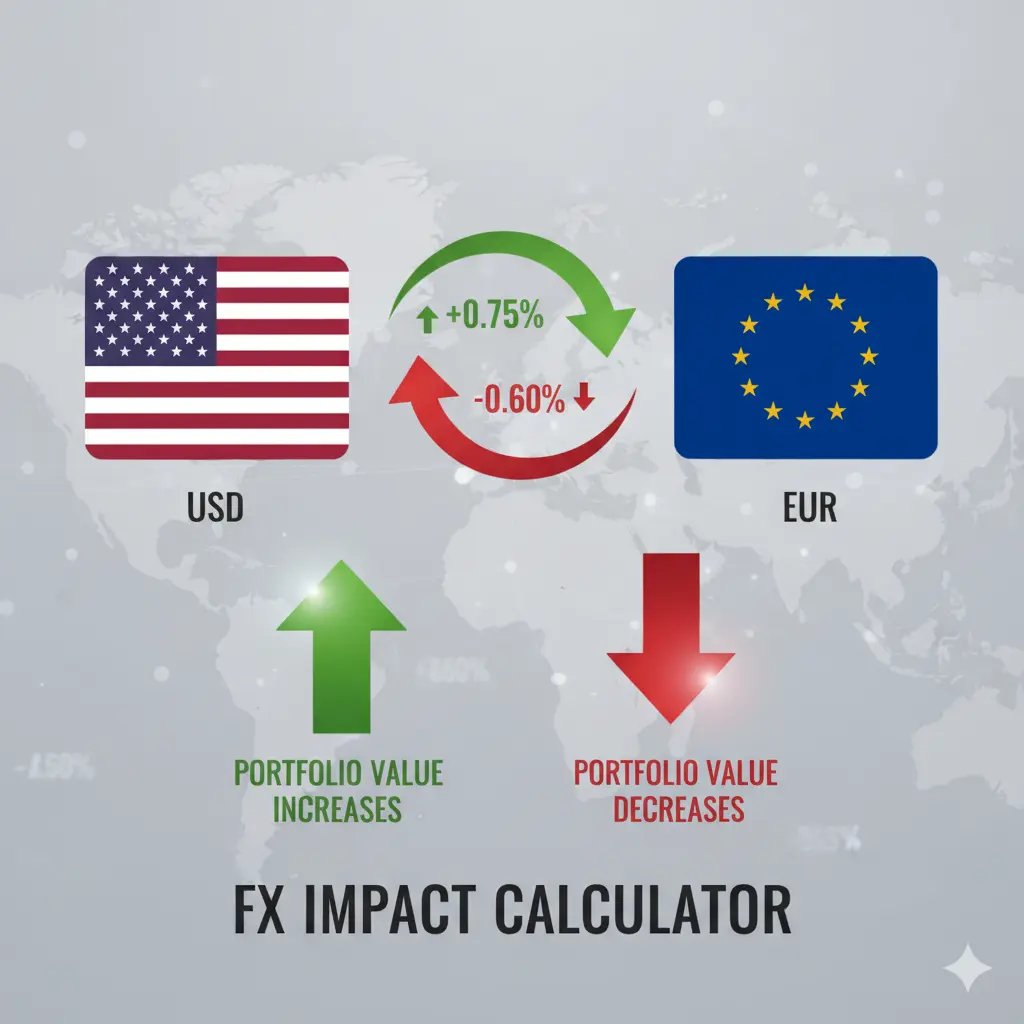
When you invest in assets denominated in a foreign currency, your actual return depends on two things: how the asset performed AND how the exchange rate moved between the two currencies.
This is something many international investors overlook. You might see your US stock portfolio up 10% for the year, but when you convert back to your home currency, your real return could be significantly higher or lower depending on what happened to the exchange rate.
The key principle is simple:
- If your home currency weakened against the investment currency → your returns get a boost (you're converting back at a better rate)
- If your home currency strengthened against the investment currency → your returns get reduced (you're converting back at a worse rate)
For expats, digital nomads, and anyone holding investments across multiple countries, this currency effect can easily add or subtract 5-15% from your annual returns, sometimes more than the investment return itself.
The Formula Explained
Your total return in your home currency is calculated using this formula:
Total Return = (1 + Investment Return) × (1 + Currency Return) − 1
Where:
- Investment Return = the percentage gain or loss of the asset in its local currency
- Currency Return = the percentage change in the exchange rate over the holding period
The currency return is calculated as: Currency Return = (Starting Exchange Rate ÷ Ending Exchange Rate) − 1
Why it's multiplicative, not additive:
A common mistake is to simply add the investment return and currency return together. For example, 10% investment return + 5% currency gain = 15%. But the actual combined return is slightly different: (1.10 × 1.05) − 1 = 15.5%. The difference grows with larger returns. This calculator handles the math correctly using the multiplicative formula.
Hedged vs Unhedged Investing
What is currency hedging?
Currency hedging is a strategy that aims to neutralise the impact of exchange rate movements on your foreign investments. When you hold a "hedged" investment (such as a hedged ETF), you receive approximately the same return as the underlying asset, regardless of what the exchange rate does.
When unhedged works in your favour:
If you expect your home currency to weaken, then holding unhedged investments will give you an extra return boost when the foreign gains are converted back.
When hedging protects you:
If your home currency strengthens unexpectedly, hedging protects you from losing returns on the conversion.
Practical rule of thumb:
For long-term investors (10+ years), currency effects tend to average out over time. For short-to-medium term holdings, currency moves can have a very significant impact and hedging may be worth considering.
Real-World Examples for International Investors
Example 1: Australian investor in US stocks (AUD weakens)
An Australian investor puts A$50,000 into a US S&P 500 index fund when 1 AUD = 0.70 USD. After one year, the S&P 500 is up 12%, but the AUD has weakened to 0.64 USD. Their actual return in AUD is approximately 22.75%, nearly double the index return, because the weaker AUD boosted the conversion back.
Example 2: NZ investor in European stocks (NZD strengthens)
A New Zealand investor puts NZ$30,000 into a European equity fund when 1 NZD = 0.55 EUR. The fund returns 8% in EUR, but the NZD strengthens to 0.60 EUR. Despite the positive investment return, the NZD return is reduced to approximately −1.1%, the investor actually lost money in NZD terms because the currency moved against them.
Example 3: Expat holding home country assets
An expat from Italy living in Thailand holds €20,000 in Italian equities. If the EUR weakens against the THB while they're living in Thailand, their European investments become worth less in THB terms, even if the stock price hasn't changed. This calculator helps quantify exactly how much that currency shift costs (or benefits) them.
Frequently Asked Questions
No. This calculator focuses purely on the investment return and currency impact. Transaction costs, capital gains tax, and brokerage fees are not included. For a comprehensive view of your international investment performance, consider using a multi-currency portfolio tracker.
Use the rate at which you actually converted your money. If you transferred money through your bank or broker, use the rate they applied. If you haven't converted yet, use the current mid-market rate as an estimate.
Yes. If you bought Bitcoin in USD using AUD, you can enter the BTC return in USD and the AUD/USD exchange rates to see your real return in AUD.
This calculator is designed for a single investment event. For tracking multiple investments across different dates and exchange rates, a dedicated multi-currency portfolio tracker would be more suitable.
No. Hedging removes both the upside and downside of currency movements. Over long periods, currency effects tend to balance out. Hedging also comes with a small cost (the "hedging premium"), which can reduce returns by 0.3-1.0% per year depending on the interest rate differential between the two countries.
Position Sizing, Risk Management & Cross Border Investments
For forex traders and international investors, position sizing is one of the most critical risk management decisions. A position sizing calculator for forex typically uses the 1-2% rule: you should not risk more than 1-2% of your total account value on any single trade. Given the leverage available in forex markets, a small adverse currency move can produce losses far exceeding the nominal position size. This currency impact calculator shows you those exact relationships: enter your portfolio value, the position percentage, and the expected exchange rate move to see the real P&L impact.
Cross border investments, owning assets in a different country from where you live, expose you to two layers of risk: the underlying asset's performance and the currency exchange rate between your investment and home currency. Over long time horizons, currency effects can either amplify or erode returns significantly. An investor in US stocks who earned 10% in USD terms but saw their home currency appreciate 5% against USD realised only 4.8% in local terms. This calculator models those exact cross border investment scenarios, helping you understand your true returns.
Fee movement also matters in international investing. Currency conversion fees charged by banks and brokers are typically 0.5-3% per transaction, far higher than the spread on listed forex instruments. For a €100,000 investment conversion at 2% fee, that is €2,000 per trip across the currency. For expats managing multi-currency portfolios, choosing the right financial infrastructure (multi-currency accounts, low-FX-fee brokers) can save tens of thousands over a lifetime of investing. Worthmap's currency dashboard tracks your exposure across all currencies so you can identify where unnecessary conversion costs are eroding your wealth.
Also try our Graham Number Calculator for value investing analysis, or explore all our Financial Tools.
Track Your Multi-Currency Investments Automatically
Worthmap tracks your investments across multiple currencies in real time, so you always know your true returns. No more spreadsheets, no more manual FX calculations.
Create free accountBuilt & maintained by Worthmap · Last updated September 29, 2026
Educational use only. This tool provides estimates for informational purposes and does not constitute financial, investment, tax, or legal advice. Results are based on inputs you provide and mathematical models, they do not guarantee future performance. Always consult a qualified financial adviser before making investment decisions.