
Debt Snowball Calculator
See your debt-free date and how much interest you save
Enter your debts and see how fast you clear them
Free · No sign-up · Updates as you type
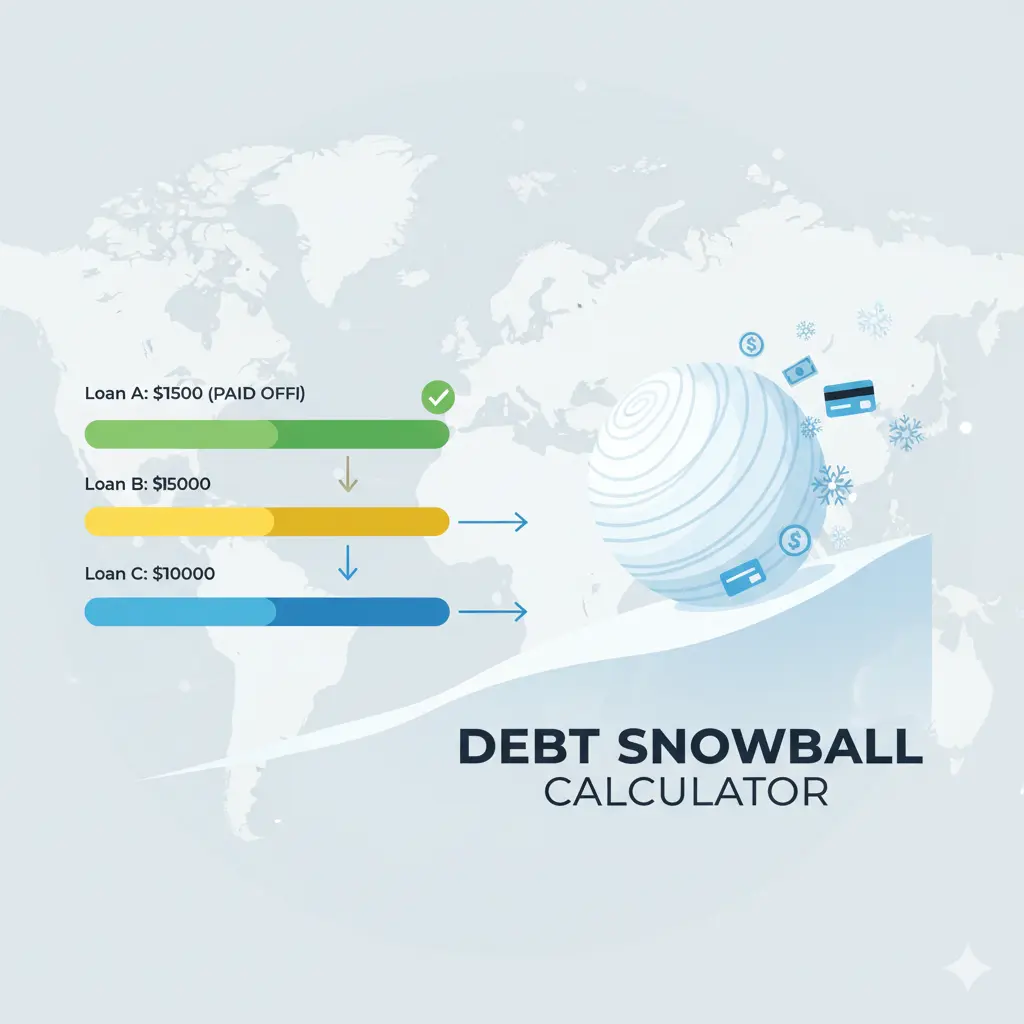
The snowball method pays your debts one at a time, smallest balance first. Each time one is cleared, its payment rolls onto the next, so your firepower snowballs. Add all your debts below and any extra you can spare each month.
Debt #1
$
$
Debt #2
$
$
Debt #3
$
$
$
What counts as extra, and what 0 does
On top of the minimums, all going to one debt at a time. Even a little helps, e.g. 200. Leave at 0 if you have nothing spare.
Debt-free in 3 years and 3 months, paying $4,241 in interest
On minimum payments alone it would take 11 years and 5 months and cost $13,312 in interest. Your plan gets you there 8 years and 2 months sooner and saves $9,072.
The numbers behind that
What you owe today
Your 3 debts added together.
$21,000
What you pay each month
$450 of minimums plus $200 extra. It stays $650 until the last debt is gone: when a debt clears, its payment moves to the next one.
$650
Interest you pay by the end
In all you hand over $25,241: the $21,000 you owe plus this interest.
$4,241
What gets you there sooner
Click an option to jump to the field you would change.
- Pay $100 more each month, $750 instead of $650: debt-free in 2 years and 9 months, 6 months sooner, with $836 less interest.
The three ways side by side
| Method | Time | Interest | Total paid |
|---|---|---|---|
Smallest first (snowball) your plan | 3 years and 3 months | $4,241 | $25,241 |
Highest rate first (avalanche) Cheapest | 3 years and 3 months | $3,774 | $24,774 |
Minimum payments alone | 11 years and 5 months | $13,312 | $34,312 |
Does the order matter?
Paying the highest rate first (the avalanche) would save you $467 in interest and finish in the same month, for the same $650 a month. What smallest first gives you in return: your first debt, Personal loan, is gone in 1 year. Highest rate first, the first one to go is Credit card, in 2 years.
How much the extra changes it
| Extra each month | Debt-free in | Interest paid |
|---|---|---|
| $100 | 4 years and 1 month | $5,741 |
| $200 (yours) | 3 years and 3 months | $4,241 |
| $300 | 2 years and 9 months | $3,405 |
| $400 | 2 years and 5 months | $2,861 |
| $500 | 2 years and 1 month | $2,477 |
Your order, smallest balance first
›
›
Highest rate first would go:
›
›
Smallest balance first. Pay minimums on the rest, throw everything spare at #1, then roll it forward.
The debt snowball, popularised by Dave Ramsey, pays debts off from the smallest balance to the largest. As each one clears, its minimum rolls onto the next, so your payment to the target debt keeps growing, like a snowball. It builds momentum and motivation.
The debt avalanche instead targets the highest interest rate first, which pays the least total interest. Both beat making only minimum payments by a wide margin. The best method is the one you keep going with.
Step 1: Add each debt with its amount owed, interest rate, and minimum monthly payment.
Step 2: Enter any extra you can put toward debt each month, on top of the minimums.
Step 3: Read your debt-free date, the interest saved, and the exact order to pay, updated as you type.
What Is the Debt Snowball Method?
The debt snowball is a payoff strategy where you list your debts from the smallest balance to the largest. You pay the minimum on everything, then throw everything you can spare at the smallest debt until it is gone. Once it clears, you roll its whole payment onto the next smallest, and so on, so the amount hitting each new target keeps growing like a rolling snowball.
The method was popularised by the personal finance author Dave Ramsey. Its strength is behavioural: clearing a whole debt early gives a real sense of progress, and many people find that a debt gone for good is what keeps them paying, even though the smallest balance first is not the cheapest route on paper.
Debt Snowball vs Debt Avalanche
The avalanche is the snowball's mathematical twin. Instead of the smallest balance, you attack the highest interest rate first, which pays the least total interest over the plan. On paper it is the cheapest and usually a little faster.
In practice the gap is often smaller than people expect, especially when your debts carry similar rates. The snowball usually costs a bit more interest but delivers quicker wins that keep you motivated. The avalanche saves the most, but can feel slow if your highest-rate debt also has a big balance. The calculator shows both, so you can weigh the money against the momentum.
The Power of an Extra Payment
Even a small extra of 50 to 200 a month can shave years off your timeline. Extra money goes straight to the principal, so less balance earns interest next month, which frees up more of your payment the month after. It compounds in your favour. The usual sources are trimming a few subscriptions, selling things you no longer use, a side income, or steering a raise or bonus at the debt. Consistency matters more than the size of the amount.
Frequently Asked Questions About the Debt Snowball
With the same extra payment, the avalanche (highest rate first) is usually a little faster and cheaper, because you kill the most expensive interest first. The snowball (smallest balance first) clears whole debts sooner, which feels great and keeps people going. The gap is often small, so the best method is the one you will actually stick with.
Usually no. Most planners keep the mortgage out and attack consumer debt first: credit cards, personal loans, car loans, student loans. A mortgage is large and low-rate, so once the costly debt is gone you can decide whether to overpay it or invest instead.
You still gain a lot. As each debt clears, its old minimum rolls onto the next one, so your payment to the target debt keeps growing even with no new money. Set the extra to 0 here and compare it to the minimum-only row to see how much the rollover alone saves.
Extra money goes straight to the principal, so less balance accrues interest next month, which frees up even more of your payment the month after. It compounds in your favour. Even 50 to 100 a month can cut years off the plan.
See Your Full Financial Picture
Paying off debt is one half of the story. Track your assets, debts, and net worth in one place with Worthmap, and watch your progress as the debts shrink and your wealth grows.
Create free accountBuilt & maintained by Worthmap · Last updated September 29, 2026
Educational use only. This tool provides estimates for informational purposes and does not constitute financial, investment, tax, or legal advice. Results are based on inputs you provide and mathematical models, they do not guarantee future performance. Always consult a qualified financial adviser before making investment decisions.